Can we just appreciate for a second how much the world needs more activities that are genuinely meditative, genuinely creative, and genuinely accessible to anyone regardless of artistic ability?
Because Zentangle is exactly that. And it doesn’t get nearly enough credit.
If you’ve never heard of it, Zentangle is about to become your new favorite thing to do with a pen and a small piece of paper. And if you have heard of it but thought “oh that’s not really for me,” she’s here to gently change your mind.
So What Actually Is Zentangle?
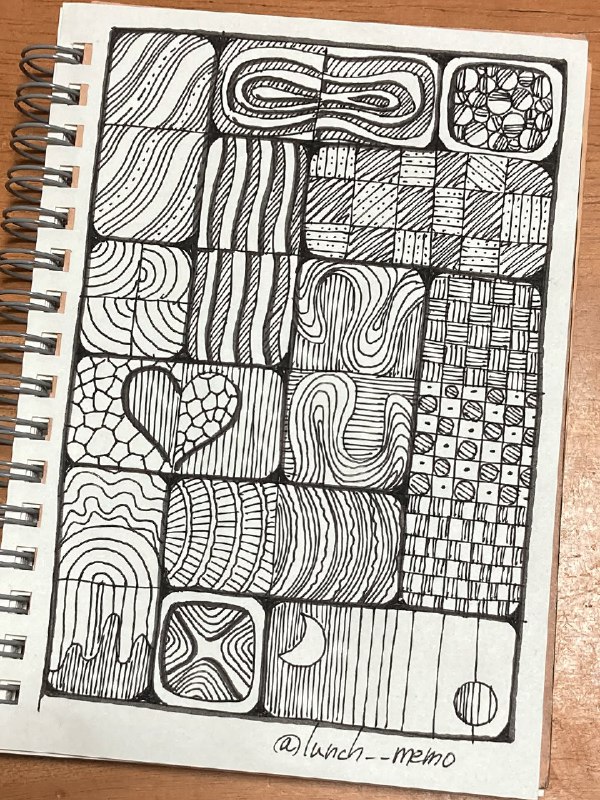
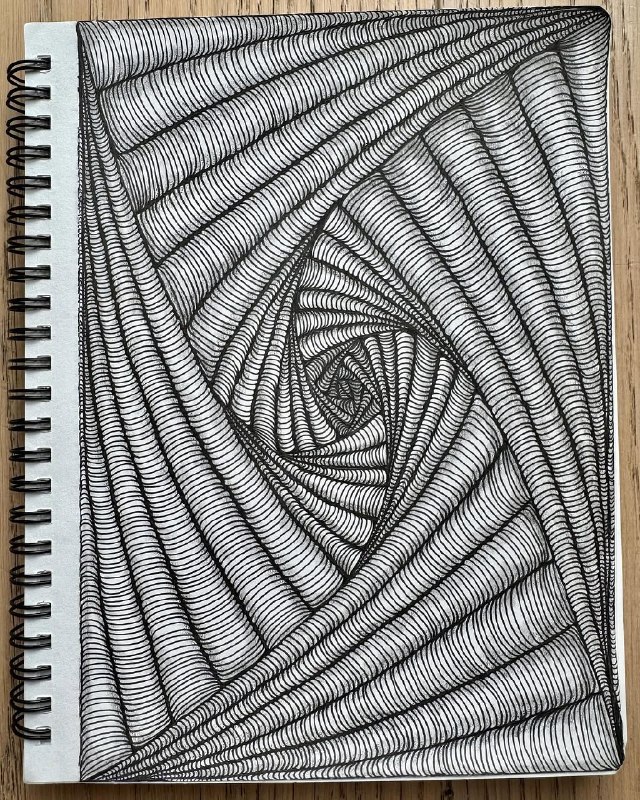
Zentangle is a structured drawing method created by Rick Roberts and Maria Thomas in the early 2000s. The basic concept: you draw repetitive, structured patterns (called “tangles”) inside a defined space, one small section at a time, without planning the outcome in advance.
No sketching ahead. No erasing. No knowing where it’s going before you get there.
The result is always surprising, always unique, and almost always beautiful in that organic, intricate way that makes people ask “wait, you drew that?”
But here’s what makes Zentangle different from just doodling: it’s intentional. There’s a method, a ritual, a specific way of approaching the page that turns it into something closer to meditation than art-making. The repetitive mark-making quiets the mental chatter in a way that’s hard to explain until you’ve experienced it.
The Official Method
The traditional Zentangle method has a specific ritual that’s worth knowing even if you eventually develop your own approach.
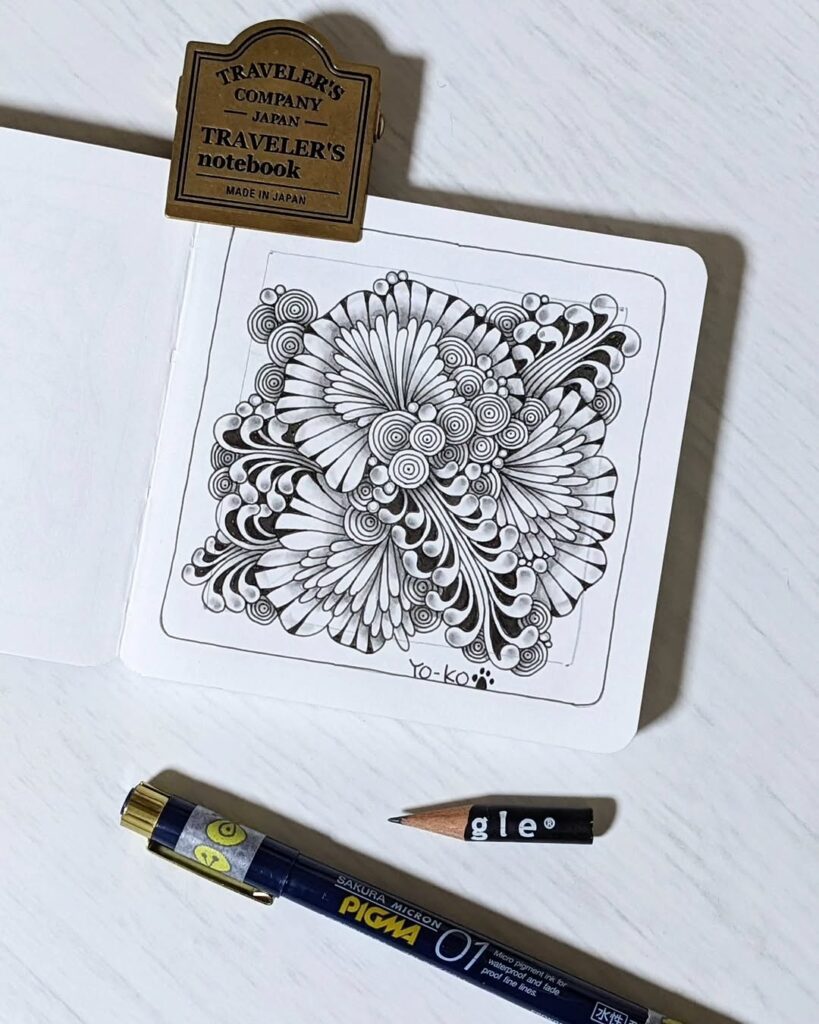
The Materials Official Zentangle uses small 3.5 inch square tiles of high-quality paper, a fine black pen (Sakura Micron is the classic choice), and a pencil for the initial string.
The Process Start by holding the tile and taking a breath. This sounds cheesy but it genuinely sets the intention. Then with pencil, draw a light, organic border near the edges and a loose “string” – a curved line or series of lines that divides the tile into sections. These sections become your spaces to fill.
Then with pen, fill each section with a different tangle pattern. Work slowly and deliberately. Rotate the tile as you go so you’re always drawing from a comfortable angle. There’s no right side up in Zentangle.
Finally, add shading with pencil to give the patterns dimension and depth. Then sign and date the back.
The whole thing takes anywhere from fifteen minutes to an hour depending on how deep you go.
Core Tangle Patterns to Learn First
Here are the foundational patterns that every Zentangle beginner should try. None of them require artistic skill – just patience and a willingness to repeat a simple mark.
Hollibaugh Overlapping straight lines that create a woven, layered effect. You draw sets of parallel lines that pass behind each other. Simple, satisfying, and looks impressive fast.
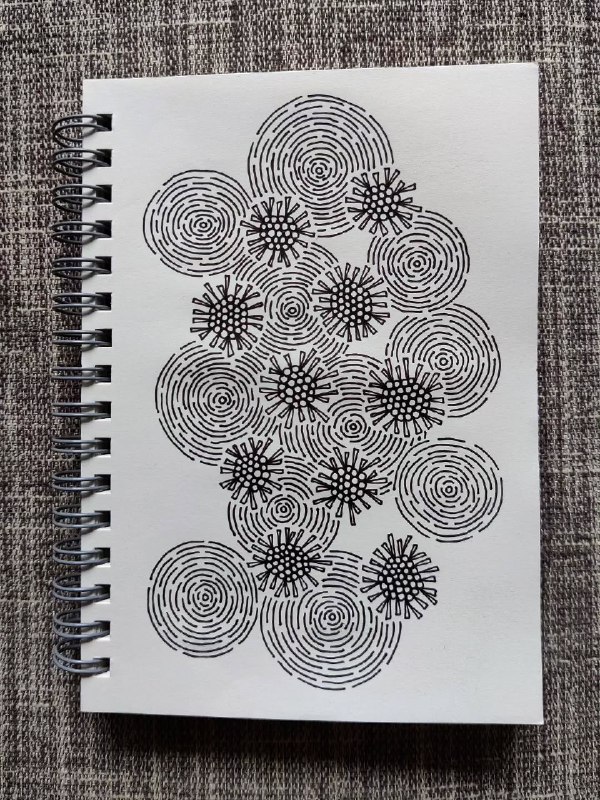
Printemps Spirals. Just spirals packed together filling a space. Start from the center of each spiral and work outward. Varies the size for organic feeling.
Crescent Moon Curved lines that stack progressively smaller inside each other, creating a crescent or lens shape. Very meditative to draw and beautiful in clusters.
Flux Leaf or petal shapes arranged in a flowing, organic pattern. Looks botanical and delicate. Great for filling curved sections.
Jetties Parallel lines with small perpendicular lines crossing them at intervals. Like a ladder laid on its side. Simple but creates great texture.
Tipple Circles. Just varying-sized circles packed closely together filling a space. Incredibly simple and looks like bubbles or cells. Very satisfying.
Cubine Repeating cube shapes that create an optical illusion of three-dimensionality. Slightly more complex but the result is seriously impressive.
W2 Wavy parallel lines that undulate across a section. The waves can be tight and regular or loose and organic. Very relaxing to draw.
Knightsbridge A checkerboard pattern with alternating filled and empty squares. Fill half with black and leave half white. Then add detail to the white squares. Graphic and bold.
Aura Trace the outline of any existing pattern to create a “halo” effect around it. This isn’t a standalone tangle but a technique that adds depth to everything.
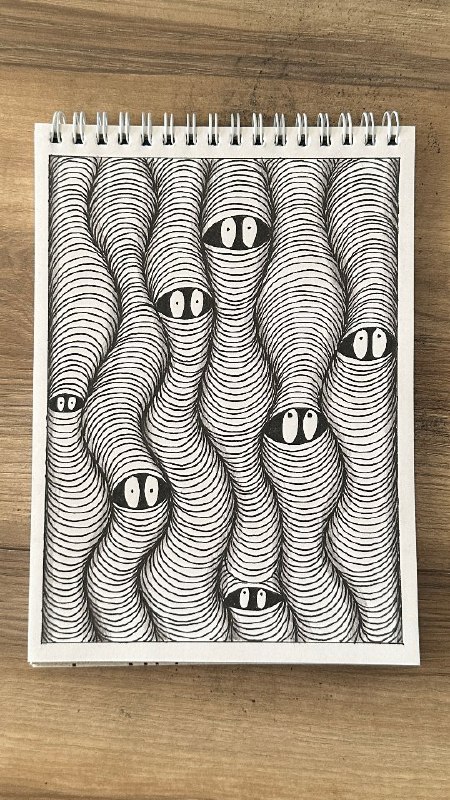
Zentangle-Inspired Art (ZIA) and Zendoodles
Once you know the basic method, Zentangle-Inspired Art and Zendoodles opens up a whole world of creative possibilities. ZIA uses tangle patterns but applies them outside the strict traditional format.
Tangled Portraits Sketch a simple face or silhouette and fill sections with different tangle patterns. The contrast between the recognizable form and the intricate filling is really striking.
Tangled Animals Same concept with animals. A butterfly with each wing section filled with a different pattern. An elephant whose body sections are all different tangles. An owl filled entirely with overlapping circular patterns. Absolutely beautiful.
Tangled Letters Write your name or a word in large block letters and fill each letter with a different tangle. Great for personalized gifts or wall art.
Tangled Mandalas Combine Zentangle patterns with mandala structure. Draw a circular mandala framework and fill each section with tangles. The symmetry plus the intricate patterns is next level.
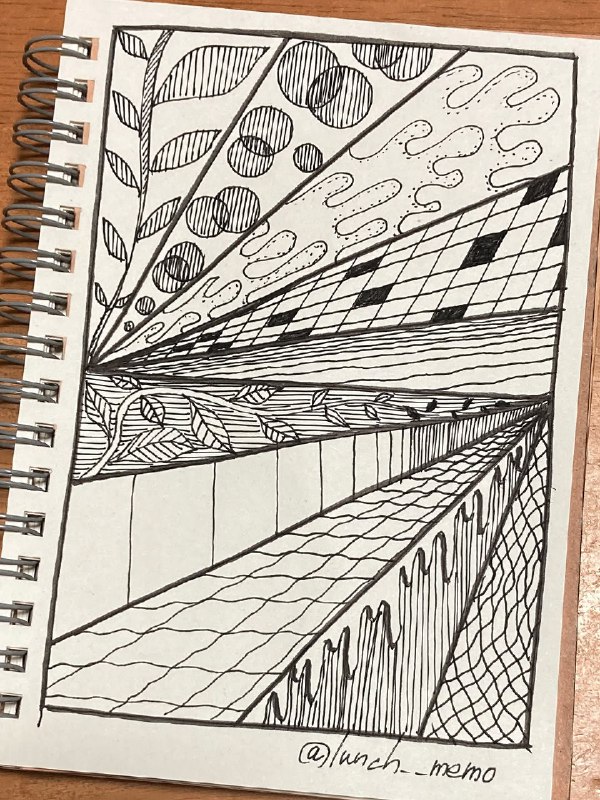
Tangled Landscapes Draw a simple landscape outline – hills, trees, a horizon – and fill each section with different patterns to suggest texture and depth. Sky filled with W2 waves, hills with Flux, foreground with Tipple.
Tangled Botanicals Draw leaves, flowers, or branches and fill them with patterns. Each petal gets its own tangle. Each leaf section gets a different texture. Looks absolutely stunning framed.
Tangled Geometric Shapes Hexagons, triangles, diamonds, pentagons – fill geometric frameworks with tangle patterns for that modern, graphic look that works beautifully as wall art.
Tangled Maps Draw a map outline (real or imagined) and fill different regions with different tangle patterns. Each country or territory gets its own texture. Wildly time-consuming and wildly satisfying.
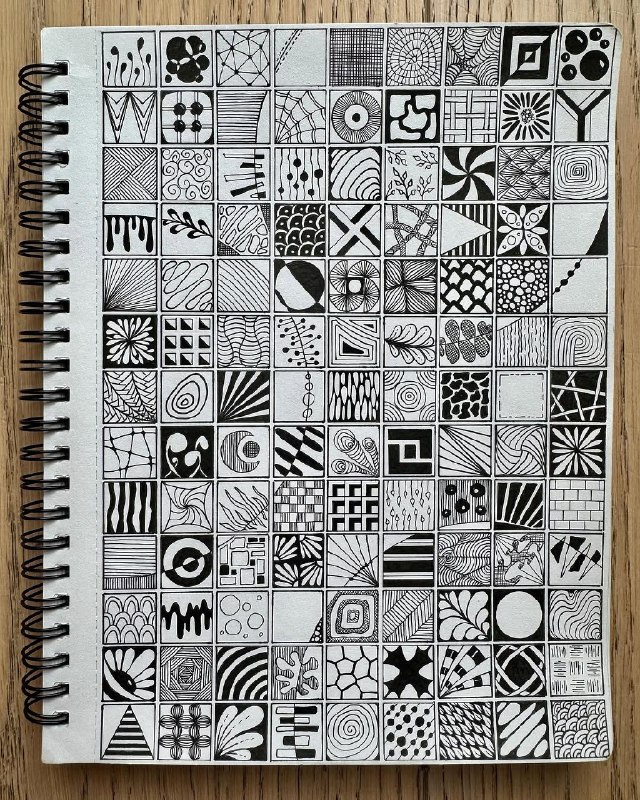
Color in Zentangle
Traditional Zentangle is strictly black ink on white paper. But the broader Zentangle-Inspired world has embraced color in the most beautiful ways.
Watercolor Background First Paint a loose watercolor wash, let it dry completely, then draw tangle patterns on top in black ink. The contrast between the soft color and the precise lines is gorgeous.
Colored Pencil Shading Instead of graphite shading, use colored pencils to add dimension. Choose analogous colors for subtle depth or complementary colors for bold contrast.
White Ink on Dark Paper Draw tangle patterns with white gel pen or white ink on black or dark colored paper. Completely changes the mood – feels much more dramatic and sophisticated.
Gold and Metallic Accents Add gold or silver gel pen details on top of finished black ink tangles. Just a few metallic lines can elevate the whole piece.
Tombow or Brush Pen Color Fills Fill sections with alcohol markers or brush pens before adding tangle details on top. Creates stained glass-like effects.
Pastel Chalk Backgrounds Blend soft pastels across the page, fix with hairspray, then draw tangles on top. Dreamy, soft, and really beautiful.
Zentangle for Different Moods and Intentions
One of the underrated things about Zentangle is how different pattern choices and approaches can serve different emotional needs.
When You’re Anxious Choose highly repetitive, simple patterns like Tipple or W2. The rhythmic, predictable mark-making is genuinely calming. Don’t think about the composition – just repeat the mark.
When You Need Focus Choose more complex patterns that require attention like Cubine or intricate geometric tangles. The mental engagement crowds out distracting thoughts.
When You’re Processing Something Work intuitively without planning. Let the string divide the page however it wants to, choose patterns by feel, and let the subconscious lead. Often produces your most interesting work.
When You Want a Creative Challenge Set constraints. Only use three patterns. Only use curved lines. Complete a tile in under fifteen minutes. Constraints produce surprisingly creative results.
When You Just Need to Decompress Put on a podcast or music, make a cup of tea, and draw slowly with no agenda. Pure enjoyment, no outcome required.
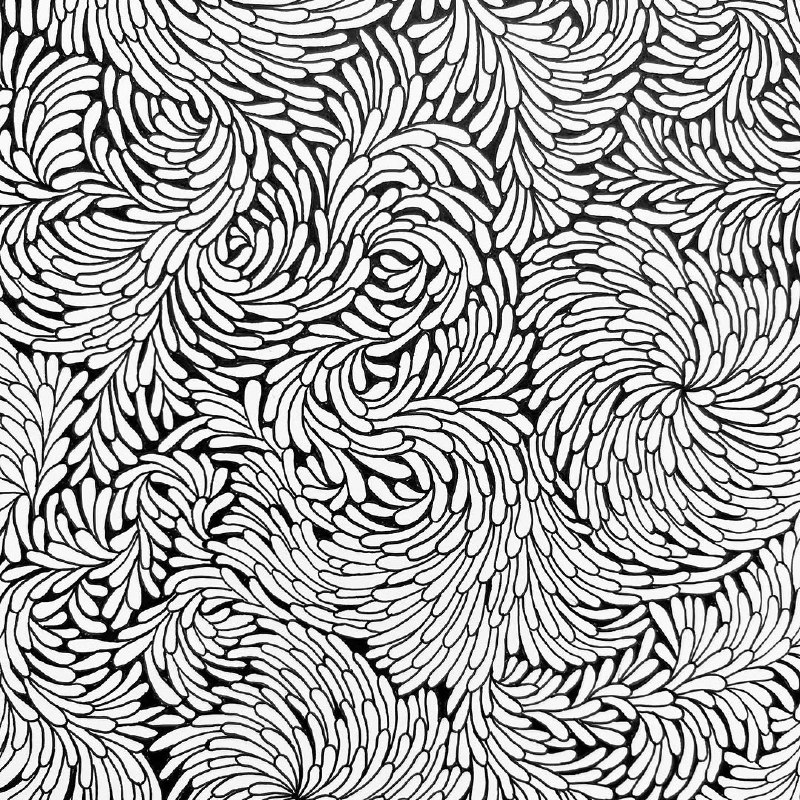
Journal and Planner Integration
Zentangle doesn’t have to live only on tiles. Integrating tangle patterns into your existing journals and planners adds incredible visual richness.
Border Decoration Frame journal entries or planner pages with tangle pattern borders. Even a simple repeated pattern along one edge transforms a plain page.
Divider Pages Create fully tangled pages between sections of your journal or planner. Visual breathing room that’s also beautiful.
Headers and Titles Fill block letter headers with tangle patterns. Your journal sections and planner months suddenly look incredibly intentional.
Background Texture Draw a light tangle pattern across an entire page as a subtle background texture, then write or layer on top.
Doodle Margins Fill margins of journal entries with small tangle patterns while you’re thinking or between writing sessions. The margins of a well-used journal become their own artwork.
Cover Decoration Fill your entire journal cover with tangle patterns. One of the most satisfying projects and the result is a truly one-of-a-kind journal.
Materials Worth Knowing About
You genuinely don’t need much to start Zentangle. But if you want to explore further, here’s what’s worth knowing.
Pens Sakura Micron fineliner pens are the classic choice. They come in different nib sizes – 01 and 05 are most useful. Staedtler Pigment Liners are a great affordable alternative. Avoid ballpoint pens – the line quality isn’t the same.
Paper The official Zentangle tiles are lovely but not necessary. Any smooth, thick white paper works. Hot press watercolor paper is excellent if you want to add color. Sketchbooks with thick pages work perfectly for ZIA work.
Pencils A soft pencil (2B or 4B) for strings and shading. Harder pencils don’t blend as smoothly.
Blending Stumps For smoothing pencil shading. Makes a big difference in the polished look of finished pieces.
Colored Supplies Watercolors, colored pencils, Tombow dual brush pens, and gel pens (especially white and gold) are all worth having if you want to explore color work.
Starting Right Now
Here’s the thing about Zentangle that she loves most: the barrier to entry is genuinely almost zero. You need a pen, a piece of paper, and about fifteen minutes.
If you’ve been telling yourself you’re not creative, Zentangle is here to respectfully disagree with you. Creativity isn’t about talent. It’s about showing up and making marks and seeing what happens.
Grab a pen. Draw a square. Divide it into sections. Fill one section with circles. See what happens next.